
CASE 2:
RE-ORGANIZATION OF AN OLD FAMILY HOUSE
This household sits quietly along the village lane, facing both the fields and the old road. Here lives an elderly farming couple who now live in a recently built compact mud-brick home, constructed just behind their ancestral house. Once the center of a large extended family, the older home still stands, with its thick walls, wooden beams, and sunlit terraces, but its rooms are now mostly unoccupied, used for seasonal storage, visiting relatives, or occasional chores. The parents’ decision to build a new home reflects a shift common in Mane: the spatial reorganization of the extended family in response to migration and generational dispersal. Most of their children have moved out for education or work, leaving only one adult son living with them. The new home is modest but carefully designed for winter warmth and summer ventilation.
A sun-facing entrance opens to a small kitchen and prayer nook, while the rear connects to a narrow strip of vegetable garden and a shared water tap. From here, the father leaves each morning to tend to the family’s portion of farmland, often joined by neighbors or kin, following the village’s enduring ethic of communal labor.
Across the lane, their brother’s family still resides in the older ancestral house, occupying its upper floors and granary spaces. The two households remain socially and agriculturally linked, often working side by side during the sowing and harvest seasons. While they no longer sleep under one roof, the pathways between them, both physical and relational, remain. This household reflects both departure and continuity: enabling the older generation to retain independence while staying tethered to kinship and field. The home becomes a quiet archive of what has stayed, and what has gently moved on.
The 200 year old mud house that now sits dilapidated and abandoned in front of the street leading to the fields.


Owned by a big family that owns multiple farmlands in the village.
Only the lower floors are used in winters as rooms for cattle's while the upper floors sometimes holds granary.
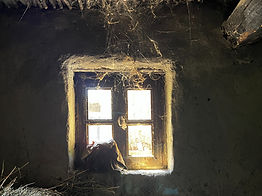
The upper floors of the mud house, with small windows in facing north indicating a winter room with lofted grain storages.
While huge windows on the souther facade locating the summer rooms.


A gharat is a small mill built on a stream or irrigation channel, converting flowing water into rotational grinding action.
Gharats primarily ground barley, maize and wheat, and could also crush oilseeds (mustard) to make cooking oil.
The use of Gharat and other traditional farming tools is declining since newer machines are been brought into the villages.


Section through the Gharat and the slopes across river
