
CASE 1:
A MUD HOUSE (BELOW) & HOMESTAY (ABOVE)
This household belongs to Lobzang, a farmer and homestay owner whose daily routines involves both subsistence and hospitality. Her family lives in a two-story home built in 2018, oriented to catch the morning sun and welcome seasonal guests. Lobzang manages both the home and the homestay while tending to her fields and kitchen garden. Her elder son studies medicine in Shimla, and her younger son, sent to become a monk as a child, now resides at a monastery. Her husband works with the administrative office of the Spiti sub-district, commuting between Kaza and Mane when needed.
Just across the lane lives their extended family, Lobzang’s brother-in-law and his family. As the eldest son, he inherited most of the ancestral farmland, and their household remains anchored in agriculture. The two families often work together during sowing and harvest, continuing the practice of communal labor that has long shaped the rhythms of life in Mane.
Despite the economic divergence, tourism on one side, agriculture on the other, the families remain closely connected through kinship, labor, and land.The house itself reflects this layered transition. The upper floor is designed to accommodate guests, with large windows, attached toilets, and a prayer room. Downstairs, a family kitchen opens into a sunlit courtyard that connects to the old mud-brick house, now used for storage, livestock, and seasonal overflow. Renovations over time have adapted the home to shifting economic opportunities, reflecting both the family’s aspirations and a sensitivity to tradition. From rearranged sleeping quarters to a repurposed front yard, the domestic space tells a story of change, where hospitality, memory, and seasonal labor converge.
The space between the neighboring house and the homestay is used as a shared space for outdoor activities like making alcohol, washing clothes and dishes.


Elevation earth bounded from the sides.The structure above was added in 2016 when the family started a homestay business for additional income.
The family/guest room which is used as a coomon/dinning gathering space by the homestay guestes.
It has a bukhari(fireplace) at the center of the room around which the saeting is arranged


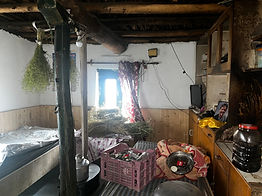
The mud house below is where the family stays if its peak tourist season.
All the wet spaces for washingclothes and utensils are situated outside.
The yard between their extended families house is where they do oudoor cooking and make alcohol.
The mud house below is where the family stays if its peak tourist season.
All the wet spaces for washingclothes and utensils are situated outside.
The yard between their extended families house is where they do oudoor cooking and make alcohol.


A sketch of the common gathering spaces in both the houses (neighboring)
